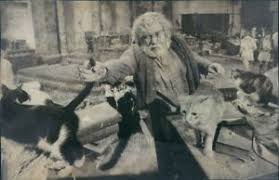

In the film Excalibur, Nichol Williamson as Merlin has a quiet moment, musing as a cake is being slowly passed to King Arthur at the Round Table. He says “Looking at a cake is like looking at the future; until you’ve tasted it, what do really know? And then, of course, it’s too late.”
As a preacher, I know what he means.
Sometimes, you have the privilege of speaking words of comfort, unpacking some of the most inspiring and hopeful passages in the Christian tradition.
And sometimes we draw today’s Gospel reading.
It’s a mélange, quite honestly, skipping from thought to thought, sometimes seemingly entirely unrelated to what came before and what follows after. The passage shifts between invocations of the death of the unworthy disciple’s soul in hell, and adjurations to follow Jesus in taking up the cross and following him, reminding us that those who find their lives will lose it, and that those who lose their life for Jesus’s sake will find it. But I think the core of this somewhat connected series of sayings can be found here:
Are not two sparrows sold for a penny? Yet not one of them will fall to the ground apart from your Father. And even the hairs of your head are all counted. So do not be afraid; you are of more value than many sparrows.
Here is Jesus telling his followers—and us, as his followers, all these years later—that we are loved by our Maker, that we are valued by our creator. And not just valued because we are obedient; this particular pericope, or quotation, unlike some of the others in today’s Gospel is not linked to any suggestion of hell or unworthiness. In the middle of a series of statements that are as much warnings as they are reassurances, this passage says simply to us: We are loved.
And not only are we loved, but everything that is created is loved.
Years ago, I studied medieval literature as part of the requirements for my degree. And we spent most of our time on the really dramatic stuff—Norse legends, Icelandic sagas, in which warfare led to feuds, which led to destruction of whole families and tribes.
The key to understanding medieval literature, though, was not the stories themselves; it was understanding what was known as The Great Chain of Being.
Two great literary scholars—C. S. Lewis in his book The Discarded Image (1964) and E.M.W. Tillyard in his book The Elizabethan World Picture (1942) explain the “Great Chain” as depicting all of Creation as emanating from God, shedding life and light on every created thing—angels, humans, animals, all the way down to the inanimate rocks and stones, in a kind of dance, a dance of a beloved creation.
Just as Jesus in today’s Gospel compares us to the sparrows, so too does medieval literature. Here we are compared with the sparrows who do not fall without God’s mourning for them.
In 627 AD, King Edwin who was himself convinced by the Christian faith as the missionary Paulinus had taught him, but Edwin felt he needed to consult his counsellors.
The first counsellor complained that their gods did nothing for him, and that the king didn’t like him anyway. (This counsellor I think may have been a remote ancestor of the well-known theologian Eeyore). A somewhat more helpful advisor stood and said,
“When we compare the present life of man on earth with that time of which we have no knowledge, it seems to me like the swift flight of a single sparrow through the mead hall where you are sitting with your thanes and counsellors. In the midst, there is a comforting fire to warm the hall. Outside the storm of winter rains and snow are raging. This sparrow flies swiftly in through one door of the hall, and out through another. While he is inside, he is safe from the winter storms, but as he flies out, he is lost into the wintry world from which he came. [1]
We are like the sparrow, swooping into the warmth to escape the cold, and, inevitably, leaving to the mysterious darkness from which we came. But as Lewis and Tillyard remind us, that place isn’t cold or dark when we get there. It’s our natural home, the place we were always destined to go—home, the long way around.
The Great Chain of Being is a model of Creation as an interlocking set of relationships, in which all that is in the world meet in loving relation to each—in which each has its own purpose, its own unique and irreplaceable contribution to the world.
The struggles of our family members, elders, sisters and brothers in the LGBTQ+ communities was waging when I came of age. I was born only a scant three years before Stonewall, and came into adulthood learning from them. One of my heroes, my cousin Bob, was a great Shakespearean actor, whose performances in Shakespeare, Marlowe and Chekov literally changed my life, opening up a world of wonders to me through the theater. His long and happy relationship with his husband Alan was a gift to our whole extended family.
We are living in a time in which repressive forces seek to silence and shame those who continue the good work of claiming their freedom to live and love as they find themselves called to. We have seen women’s legal rights to control their own bodies and protect their health abrogated just a year ago, and some of those same forces are targeting our GLBTQ+ sisters and brothers in the hope of erasing their importance in our common life and in our world. But I take comfort from G.B Trudeau’s reminder that “Backlash never plays like the original.”
And Today has been a good day.
This morning, we heard from the Right Reverend Deon Johnson, of the Diocese of Missouri, sharing his experiences as the first openly gay black bishop in our Church.
As usual, St. Barts had a contingent marching in the Pride parade, the annual BBQ on the terrace, and we celebrated the musical contributions of LGBTQ+ composers who have enriched our lives and our worship.
For today, the Great Chain of Being is dazzling, with all of our individual and shared contributions, glowing—dare I say it—with all the fresh beauty of the rainbow. And we at St. Barts have kept lighted this day such a candle, by God’s grace, in New York City, as I trust shall never be put out.
Happy Pride Sunday, St. Barts.In the Name of God, Creator, Redeemer, Sustainer.
[1] Leo Sherley-Price, ed., Bede, A History of the English Church and People, (Dorset Press: Middlesex, 1985), p. 127.
 ANGLOCAT ON The Prowl: A Deacon's Miscellany
Leave a comment