This morning, we performed one of the great sacraments of the Church—we baptized a baby, nearly six months old, into the Christian faith. His name is Keaton Aldo Laudel, and his parents Ashlyn and Andrew Laudel were joined by his godfathers Jake and Camden. Baptism is a beginning, the first step in what is intended to be a life-long relationship between the baptized, the family of the person to be baptized, and the expression of the Faith into which the baptized is received.
It seems such a little thing, the wetting of the baby’s head with the Holy Water in the font; the holding up of the child (in this case), and welcoming the baby into the household of God, and we instruct him to confess the faith of Christ crucified, proclaim his resurrection, and to share with us in his eternal priesthood.”
No pressure, am I right?
More helpful, I think, are the prayers we offered and continue to offer for Keaton. We ask God to sustain him in the Holy Spirit, to give him an inquiring and discerning heart, the courage to persevere, a spirit to know and love God, and the gift of joy and wonder in all God’s works.
So, for now at least, little Keaton can have a rest, trust in his parents and godparents to do the heavy lifting until he grows into the prayers and promises that have been made on his behalf—to renounce Satan and all the spiritual forces of wickedness that rebel against God. to renounce the evil powers of the world which corrupt and destroy the creatures of God. (No, that does NOT include the MTA), to renounce all sinful desires that draw him from the love of God.
The Canadian writer Robertson Davies underscored in his book The Rebel Angels that the godparents make these vows on behalf of the child, not for themselves, as they may find themselves, depending on circumstances, traveling or even living in places that are neither light nor dark; as is sometimes the way of the world.
More positively, the godparents turn to Jesus Christ and accept him as Savior—again on the child’s behalf—put their trust in his grace and love, and, finally, promise to follow and obey him as his Lord.
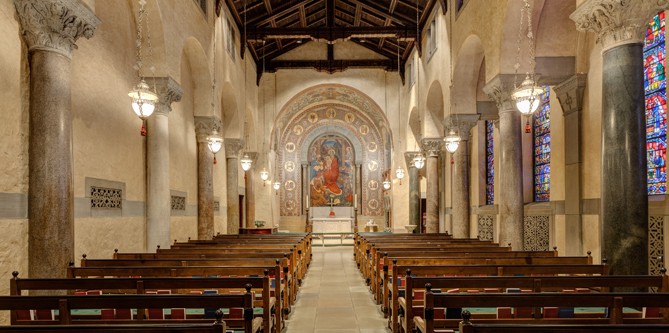
We love a baptism here at St. Barts—we have not one but three baptismal fonts—the handsome portable font we used today, the winged angel marble font in the Baptismal chapel just behind the stalls, and the tiny font here in the Chapel.
I remember on what was my first Sunday as a deacon here, I was accosted by Lynn Sanders, then our Vicar, who asked me if I was up to baptizing a baby. It was the Sunday of the Baptism of Our Lord, and of course I couldn’t refuse—so I didn’t. The baby was a lovely little girl, and when she was handed to me, she snuggled into my arm. I had never thought of the trust our parents and godparents place in our clergy. I was fortunate that she accepted my pouring the water over her head the traditional three times, although by the end, she gave me a look that suggested that she thought that I was getting lost in the part.
Welcoming a newcomer into the household of God, embracing the promises, the prayers, and holding and baptizing that patient little girl—that was the moment when my ministry coalesced into the reality of service to God and His people. It’s getting on for a decade of ministry, here at St. Barts, and that decade began as I hopefully scooped water into my palm, and conferred a sacrament in all earnestness.
I’m not the only clergy person at St. Barts who lights up at a baptism. Early in Dean’s time at St. Barts, a young Englishman who had come to the 11:00 service came up to me, and asked if he could be baptized. I remember telling him firmly to wait where he was, and quickly found Dean. I explained the circumstances, and Dean smiled and murmured, quoting from the Ethiopian eunuch, a court official of Candace, queen of the Ethiopians, and he said “See, here is water! What prevents me from being baptized?” We grinned, and Dean brought Lynn with him, and we baptized the young man on the spot.
But that brings us to our Gospel reading at last.
John the Baptist is, as Luke tells us, the son of Zechariah, a priest in the Temple of Jerusalem, which makes him a descendant of the first priest, Aaron. Even under the Roman occupation, the priests of the Temple enjoyed a certain level of privilege, of respect from the people and, legally, from Rome, which used such privilege as a tool to make the Temple authorities to some extent useful in keeping the people obedient. This son of the Temple, though, is nothing like the collaborationist priests that Jesus clashes with in his later ministry. No, John the Baptist is very different indeed. For one thing, John leaves the Temple behind, and finds his ministry along the banks of the Jordan River. He proclaims his baptism for the forgiveness of sins, and hears confessions from those who come out to him. He reminds the soldiers who seek him out to not abuse their power to steal from the people who are pretty much at their mercy, and urges the tax collectors to take only what is due.
A bit like our own time, Jesus and John were born into a land of strained loyalties. The people of Israel were a conquered nation, and many of their leaders fell in with the Roman Establishment, in return for which, they remained leaders, and alive. The Roman occupation inflicted violence from the powerful against the common people, with extortion, theft, and sometimes far worse. Crucifixion was not an unusual punishment; it was wielded against those who were considered enemies of the Occupation and the occupiers, and were unlucky enough to be caught, or were betrayed. The people were looking to God for rescue, hoping to find the Messiah in their midst, but not knowing how to recognize him.
John can also sometimes be more than a bit scary—In Matthew 1:3, 1-12 John meets the Pharisees and Saducees approaching him to be baptized, he bellows at them: “You brood of vipers! Who warned you to flee from the wrath to come? Bear fruit worthy of repentance. Do not presume to say to yourselves, ‘We have Abraham as our ancestor’; for I tell you, God is able from these stones to raise up children to Abraham. Even now the ax is lying at the root of the trees; every tree therefore that does not bear good fruit is cut down and thrown into the fire.”
But it always begins with these two; John the Baptist, and his cousin Jesus. In Mark’s spare, elegant telling of the story, there is no sign of any prior relationship between the two. Their ways of life are very different, with John leaving the Temple, and venturing out into the wilderness, and preaching a baptism for the repentance of sins.
The Gospel reading tells us John is clothed with camel hair, wearing a leather belt around his waist, and that he ate locusts and wild honey (I could have done without that little detail myself). John never claims anything for himself, denying that he is the Messiah, Elijah, or a new prophet. Instead, brushing questions away by saying that “The one who is more powerful than I is coming after me; I am not worthy to stoop down and tie the thong of his sandals. I have baptized you with water; he will baptize you with the Holy Spirit.” Jesus would later describe John:
What did you go out into the wilderness to see? A reed shaken by the wind? “But what did you go out to see? A man dressed in soft clothing? Those who are splendidly clothed and live in luxury are found in royal palaces! “But what did you go out to see? A prophet? Yes, I say to you, and one who is more than a prophet. “This is the one about whom it is written, Behold, I send my messenger ahead of you, who will prepare your way before you. I say to you, among those born of women there is no one greater than John; yet he who is least in the kingdom of God is greater than he.” When all the people and the tax collectors heard this, they acknowledged God’s justice, having been baptized with the baptism of John”.
Today, though, we see what Jesus saw in John: The stubborn honesty of a man refusing to aggrandize himself, waiting for the one who comes after him, and fulfills his mission. Even though John knows he is making himself obsolete, he knows his duty, does it with conviction, and now, when Jesus approaches him at the Jordan, begins to bring his own ministry to its climax and its conclusion.
That Jesus will walk in the paths that John has made straight, it is Jesus who will make everything new. Each in his own way, they touch the hearts of those who have lost hope, who seethe with anger and want to punish those who have brought the people of Israel to this nadir. But John, like Jesus, do not light a flame against the compromised collaborationists in the Temple, or bay for a military leader to strike fear into the hearts of the Romans. No; they offer a different way to be active in seeking to renew he world, to bind its wounds and the wounds of the downtrodden. They forgive sins, and give hope to those who know their own failings and the harms they have inflicted.
Jesus and John, John and Jesus, even at the beginning of Jesus’s ministry, they begin to re-create the world not by force or by power; they pass on the candle of forgiveness from penitent to penitent, watching the candle go from them, to the next sufferer, and the candle passes around the circle that they have created, a circle that slowly, gradually stretches from the Jordan all the way here to St. Barts in this City. Looking all the way back to that beginning, Jesus’s baptism by John, the shape of what is to come is already being delineated. Of course, John will die because he insists on telling the truth to Herod.
Of course, Jesus will die on the Cross for the sins of others, condemned in the place of a robber. The story never ends, though, because Jesus and John, John and Jesus are always with us; the gruff, Baptist with a heart as soft as thistledown beneath his anger, the brilliant teacher in parables, defeating those who would entrap him with lies by simply replying with the truth. We celebrate them today because we need them still, as the sometimes weary world looks for forgiveness and finds it in their lives and actions.
The movement never dies, because we are all a part of it, the interlocking of hands in friendship and forgiveness, in receiving forgiveness ourselves and passing it on, an eternal circle that will never come to an end, until all things are made whole.
In the Name of the Father, Son and Holy Spirit, Amen.
 ANGLOCAT ON The Prowl: A Deacon's Miscellany
Leave a comment